Michigan has awarded $2 million to five projects testing drone and aerial technologies inside state government, from watershed monitoring to roadway safety. Here’s a look at each pilot and what it means for how Michigan delivers public services.
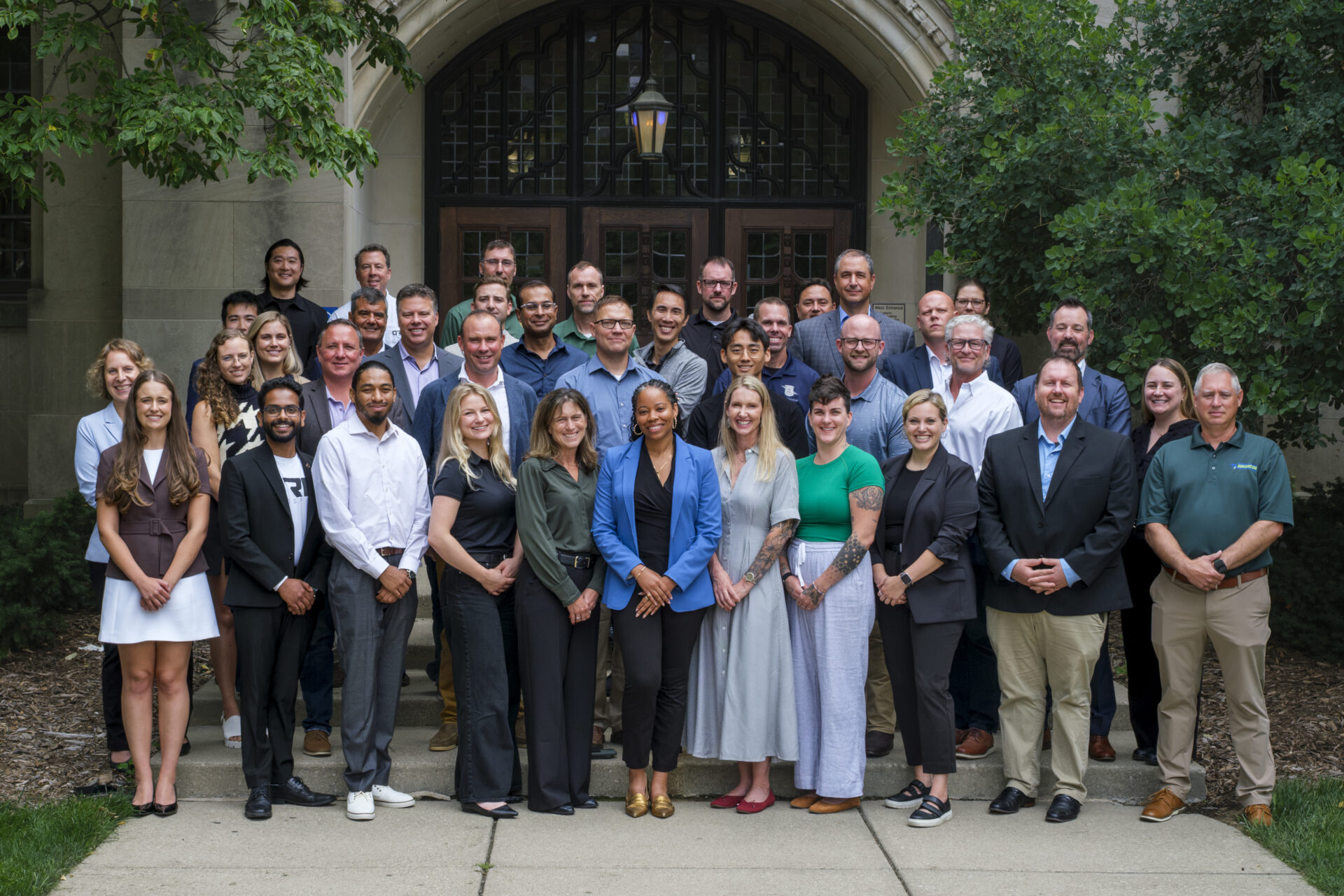
On August 12, I stood in a room at the Michigan League in Ann Arbor and watched something that had been a long time coming. Five state agencies and seven companies came together to officially kick off Michigan’s Advanced Air Mobility (AAM) Statewide Mobility Challenges, and I felt a real sense of pride in what we are building together. The projects are diverse, creating solutions for how governments approach topics like water quality, wildfire response, roadway safety, airspace security, and agriculture, and each one shows how air mobility can address issues that directly affect Michigan communities. They also will be tested to see if adopting this technology can help to keep state employees safer on the job and make state operations more efficient. What made me proudest was the mix in the room: companies that have roots in Michigan, alongside companies coming to Michigan to develop their solutions here.
NextEnergy is proud to administer and manage the program for the Office of Future Mobility and Electrification (OFME), supporting five pilot projects backed by $2 million in state funding that puts advanced air mobility to work inside state government.
Each company was selected through a competitive process and paired with a state department facing a real operational need. More than 50 applications were submitted across the five challenges. Eligible applications were reviewed and scored by committees that included representatives of the participating departments, OFME/NextEnergy, and industry experts. Finalists were interviewed before each department selected the company it determined was best suited to its operational challenge. Every applicant was required to commit matching funds and a plan for growth in Michigan, with priority given to companies ready to build drone production here. Companies were notified on a rolling basis from December 2025 through May 2026, ahead of the announcement in August.
Each pilot will allow the participating department to evaluate the technology in a real operating environment, identify potential improvements, and gather information that can guide future decisions. Here’s a look at the five pilots:
- Motorola Solutions, in partnership with SkySafe, will bring drone detection to the Michigan State Police. Motorola Solutions, a global public safety and communications technology company, invested in San Diego-based SkySafe in 2025 and integrated its drone detection technology into Motorola’s 911 command center software. The pilot will evaluate how the system can help operators detect and analyze unauthorized drone activity.
- Orb Aerospace will evaluate technology intended to strengthen wildlife monitoring, forestry management, and wildfire monitoring and mapping with the Michigan Department of Natural Resources. Orb Aerospace, based in Lowell, Michigan, builds communications and autonomous systems that keep critical operations running when infrastructure fails or is needed in hard-to-reach locations.
- Westwood AI, in partnership with Birdstop, will test road intelligence with the Michigan Department of Transportation. Westwood AI, based in Grand Rapids, Michigan, provides AI-powered drone inspection and operations for infrastructure and public safety. Birdstop, based in Detroit after relocating from California, builds drones that can fly safely in shared airspace with FAA approval while being operated remotely, and it is setting up its first manufacturing line in the city.
- Kohtari will support water quality monitoring with the Michigan Department of Environment, Great Lakes, and Energy (EGLE) in the Grand River watershed. Kohtari, based in Wilmslow, United Kingdom, uses drones, sensors, and robotics to monitor water quality, with an AI platform that predicts emerging risks. Its BloomIQ platform forecasts when and where algal blooms are likely to occur.
- AVOL will work with the Michigan Department of Agriculture and Rural Development to test whether aerial technology can assist pesticide drift investigations while keeping investigators out of harm’s way. AVOL, based in Brooklyn, New York, builds autonomous electric cargo drones for hard-to-reach rural areas, with roots in medical logistics.

08/12/26 Statewide Advanced Air Mobility Challenge Kickoff 2026 Meeting.

Connecting new technology with the people who put it to work has been at the heart of NextEnergy’s mission from the start. As drones become more capable and public agencies are asked to do more with the resources they have, Michigan has recognized the value of that same approach. With Executive Directive 2025-4, the state established the Advanced Air Mobility Initiative as a whole-of-government strategy. This investment isn’t just a grant program. It’s a new model for how government can test emerging technologies, learn from real-world demonstrations, and make more informed decisions about possible future use, and one we have been building toward.
Through our smart cities partnership with EGLE, we helped drive more than $3 million in clean energy, smart infrastructure, and electrified mobility investments across Dearborn, Flint, and Marquette. In 2025, we activated a rooftop drone testing and flight zone at the Detroit Smart Parking Lab, giving innovators a secure urban environment for real-world testing. That same year, we launched more than 20 new deployments across energy, mobility, and sustainability.
This work matters for Michigan. When state agencies and technology companies solve problems together, residents can benefit from cleaner water, safer roads, and faster emergency response. State employees get better tools for difficult and sometimes dangerous jobs, and Michigan’s drone industry gets a real chance to grow here. As these pilots get underway, NextEnergy looks forward to continuing our partnership with the State of Michigan to make the state safer, healthier, and more efficient.
About Kristin Shaw
Kristin Shaw, LEED AP, is Program Manager, Smart Cities and Communities at NextEnergy, which she joined in 2025, and is based in Detroit. With a master’s in urban planning from Wayne State University, she brings a background spanning sustainability, urban planning, and communications to NextEnergy’s work in energy and mobility innovation. She is the co-author of Women Driven Mobility and chairs the Climate Committee of the Detroit City Council Green Task Force. Her work has earned recognition as one of Crain’s Detroit Business Twenty in Their 20s and a Notable Leader in Sustainability, along with USGBC Detroit’s Outstanding Leadership in Sustainability award and Wayne State PRSSA’s Alumni Award.
